


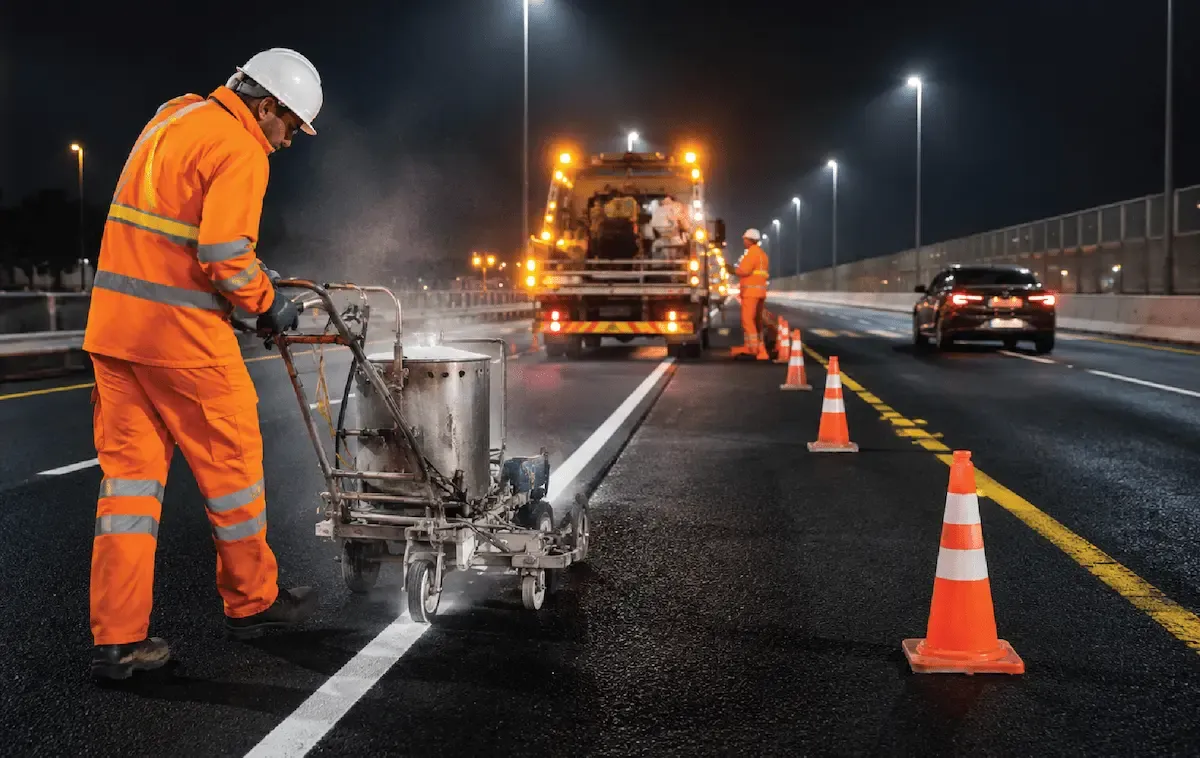
Markings on roads/pavements are clear to enable drivers, operators and pedestrians of equipment to know how a site should operate. Lines, arrows, symbols, crossings, and parking bays and restricted areas should be laid out correctly, applied to an appropriate surface and aligned to the approved layout of the traffic or facilities.
Best International Contracting Company offers road marking services to Saudi Arabia project owners, contractors and industrial facilities that can use their services to mark defined internal roads, yards, parking and access route and infrastructures. We discuss the accepted design, size, colour, material needs, and surface quality, the access control and time schedule before submitting the work.
It is our job to use the accepted marking scheme in the right way and in a constant manner. The task of the designated designer or project authority, unless it is explicitly mentioned in the contract, is the traffic engineering, road design, authority approval and the creation of a working traffic plan.
The best use of road markings is when these are a component of an organized movement strategy. Symbol or line must have a purpose, an approved position and sufficient surroundings visibility to direct the users without providing conflicting instructions.
Being a road marking contractor Saudi Arabia customers can turn to to carry appropriate projects, BIC orchestrates layout setting-out, surface preparation, masking, application, drying or curing, inspection and area release. The sequence of work is designed according to the access of the traffic, restrictions of operations and weather conditions and the quality of the existing pavement.
In areas where there is damage to the asphalt, concrete or paved surface, contamination, instability or not yet accepted, then corrective work may be necessary prior to the marking process. Repair of asphalt construction and structural pavement is still a part of the Road Construction and Asphalt Works service.
Centre Lines, Lane Lines and Edge Lines
Longitudinal markings can be applied to separate opposing movements, separate lanes or direct traffic on internal roads or mark pavement edges. The plan approved should indicate the type of line, width, pattern, colour and termination points.
To be precise in setting-out is significant on curves, approaches, cross-roads and narrow industrial approaches. The continuity and space between the lines must be verified and then the marking material should be added.
Directional Arrows and Traffic Symbols
Pavement symbols approved, such as arrows, turn signs, stop signs, speed signs and other signs can be used to further reinforce the desired direction of travel and site regulations.
Templates, dimensions and orientation should be in accordance with the approved layout. The symbols are supposed to be where the approaching users can see and comprehend without causing inconvenience to the parked vehicles, equipment or other markings.
Stop Lines, Give-Way Lines and Junction Markings
There can be access points and intersections that need stop lines, give-way lines, channelisation and turning directions. The geography of their position must be coordinated with the visibility, gates, barriers, crossings and signs placed.
BIC uses these markings based on the dimensions of project issued and setting-out information. The task of deciding what is needed in terms of traffic-control is left to the appropriate designer or authority of the facility.
Pedestrian Crossings and Walkways
Pedestrian crossing, special walkways, boundary and interconnection between buildings, parking space and working areas might be necessary in industrial, commercial and project sites.
Markings ought to be aligned with access gates and physical barriers, kerbs, and ramps. The customer or authorised project team ensure that the design of pedestrian routes and safety is assessed.
Parking Bays and Numbering
The parking layouts can be designed to have the regular bays, accessible spaces, visitor parking, fleet parking, loading bays, directional arrows and specific numbering or identification.
The scheduled approved bay sizes, aisle width, direction, and reserved spaces and numbering schedule ought to be approved before being applied. Phased markings can be used to maintain a portion of an existing parking area in areas where the site allows.
Loading, Staging and Equipment Areas
Warehouses, logistic space and industrial yards can have designated loading bays, trailer space, forklift tracks, crane clearance, or container space or staging area of equipment.
These markings ought to be in accordance with the approved operating arrangement and actual equipment sizes. BIC adheres to the layout issued, and does not decide on the lifting zones, or operational separation distances on its own.
Kerb, Island and Hazard Markings
Low obstacles and designated areas of hazards, as well as kerbs, traffic islands, columns, and other features, might need colour coded or contrast markings. The colour pattern, extent and purpose should be given by the customer.
The substrate should be clean, dry and fit the type of coating chosen. The various surfaces can have varying preparation need or systems of material that can be used.
Warehouse and Internal Floor Markings
Appropriate internal spaces might need aisle lines, footways, storage delimits, keep clear zones and floor markings. The floor type, indoor conditions and anticipated traffic should be taken into consideration in the choice of the marking material.
Large-scale surface repairs and operational-layout design, floor coatings will do so independently unless they show in the accepted road marking scope.
Service boundary: The installation and use of approved pavement markings and the interfaces of installation are discussed on this page. They are still on their special services asphalt paving, structural pavement repairs, road design, traffic engineering and signboard fabrication. The installation or coordination of signboards is only included in the accepted scope when it is mentioned.
Marking of work can be necessary on a new asphalt or concrete or on a maintenance to an existing site. New surfaces must be adequately prepared to be marked and old surfaces must be evaluated in terms of dirt and dust, oils, loose coating, old marks and local damage.
The pavement marking services that can be outsourced in Saudi Arabia can consist of new designs, replacement of worn out markings, approved colour variations, local reinstatement following maintenance work and remarking following pavement work. The given preparation will be based on the current state and the material chosen.
Writing on a bad or dirty surface can cause bad adhesion or it can be lost easily. In cases where there is a serious repair, resurfacing or coating removal, then the requirement must be known prior to the marking programme being approved.
Jubail industrial plants are frequently in need of markings facilitating regulated vehicle flow, pedestrian flow, parking, loading, restricted zones and maintenance works. Such projects can require a gradual implementation of the projects to ensure that routes are open and that there is access to emergency routes.
BIC evaluates the needs of Jubail regarding industrial road marking of internal roads, plant entrances, warehouses, logistics yards, and contractor parking, loading areas and appropriate project facilities. The work will be scheduled based on the access rules, permit system, approved work window and area-release process, at the facility.
The approved layout, colour conventions, restricted areas and areas of operation must be checked by the client or operating authority. BIC will then make and implement the markings in the agreed-upon workfront.
A full marking package must include the accessibility of the surfaces, surface approval, require clear drawings, setting-out control and inspection requirements. The lack of any of these puts the risk of rework at risk.
Since KSA customers may approach the company as a road marking company to lay down markings that may be suitable in their projects, BIC will prepare a proposal that will determine the types of markings included, the estimated quantities, material assumptions, surface assumptions, access conditions, customer responsibilities and exclusions.
The amounts can be in linear or square metre, number of symbols or number of bays or a mutually agreed system. It is important to verify the measurement foundation prior to commencing work.
Users should be provided with similar information using road markings and signs. Directional arrows, stop lines, crossings, signs concerning speed and restricted areas might require similar signs at suitable places.
Where it is necessary that a project be combined under the road marking and the signboard contractor KSA package, BIC is able to review the approved sign schedule, location, foundations or supports, installation requirements as well as coordination with the pavement plan. The proposal will indicate the signs, which are customer supplied, sourced, installed or fabricated under a different fabrication work package.
In-depth signboard fabrication, structural design, electrical sign system and access-control equipment are all subject to the appropriate fabrication, electrical or fencing services unless explicitly specified.
Marking material needs to be chosen based on the accepted specification, surface type, circumstances, traffic, mode of application, conditions of drying or curing and finish demanded. There is no universal material which can be used everywhere.
Projects can identify liquid-applied road marking paint, material of a thermoplastic nature, pre-existing road markings or any other approved system. BIC does not replace an alternative system without authorization, but after collecting the accepted requirements of the products and applications.
During approval of materials, colour, finish, thickness, requirement of reflective-media, and product documentation should be ensured. The project also needs to take into consideration availability, and lead time in case the project needs a specific brand or system.
The adhesion and appearance directly depend on the surface preparation. Dust and sand on the work area, loose aggregate, oil and grease, moisture and curing compounds, old coating and surface damage should be evaluated.
Cleaning can be of a sweeping, air cleaning, approved washing, degreasing, local removal of loose material or other designated treatment. The method selected should be able to be compatible with the pavement and marking system.
New asphalt, patched areas and coated concrete might have certain waiting times or preparation as indicated by the manufacturer of the project or product. Marking of the surface should be made until the desired condition is attained.
The markings put should be based on accepted references and not by guessing. Depending on the layout, road edges, centre lines, kerbs, building grids, parking boundaries or the survey point can be used as a reference.
Checks at the setting-out stage should be done to verify dimensions, alignment, spacing, symbol orientation, bay numbering and transitions. A representative part or sample can be provided to be accepted where it is necessary.
An independent land surveying is another service. In cases where accurate survey control or formal coordinate setting-out is needed the survey information needed should be provided by the project or the survey scope should be included separately.
The method of application will vary based on the type of marking, the size of the product and projects. During application and until the time markings are released, vehicles, pedestrians, dust and other activities should be prevented to work areas.
Monitoring should be done on line width, edges, coverage, shape and colour consistency of symbols when being applied. The spillage, the overspray or the tracks of the material ought to be avoided with the help of appropriate masking and control of the work-zone.
The time of drying or curing depends upon the material and conditions. Till the agreed-upon release is achieved, the area is to be closed.
Current markings might have to be renewed, covered, changed or removed with a revision of a layout. The treatment to be used is dependent on the past material, the pavement condition, colour contrast and acceptance requirement.
Removal of part may cause a shadow or burnish the surface. The project needs to specify the extent to which removal, approved masking, surface treatment or resurfacing is to be anticipated.
Damaged lines and symbols may be reinstituted after utility works on the approved layout with the approved marking material that is compatible.
Road marking Inspection inspection can be based on the location, sizes and straightness of the lines, continuity of a curve, shapes of symbols used, colour, coverage, edges, surface adhesion and cleanliness of the surrounding environment.
Product records and witness points, required product samples, measurements, should be specified in the approved inspection plan. BIC organises checks on the contractor side and submits the final work to be checked as per the project process.
Any damaged, misaligned or unacceptable marking must be dealt with via an approved method of correcting that does not form a bigger visual or surface defect.
The road marking operations can be conducted next to the moving vehicles, moving equipment or working facilities. The approved barriers, cones, signs, spotters or access controls that are needed in the site should be used to isolate the work area.
It is recommended that the plan should reflect on material handling, indoor working ventilation where it is applicable, hot-applied product (where applicable) and night working, lighting, pedestrian diversion and emergency access.
The official closures of public-roads, the branching of the traffic and the work controlled by the authorities presuppose the independent planning and approval. They are not presupposed to be covered in all the road marking investigations.
1.Enquiry and document review
We check the finalised layout, quantities, colours, types of marks, the material needs, location and date of completion.
2.Surface and access assessment
The pavement condition and past markings, contamination, traffic movement, work windows and area-isolation requirements are evaluated where necessary.
3.Material and method confirmation
The project requirement is aligned with the proposed product, method of preparation, application method, the requirements of curing and documentation.
4.Setting-out and approval
The lines, bays, arrows, symbols and other markings are located based on the approved references prior to the application.
5.Surface preparation
The working area is swept and made to the agreed level and any areas that do not meet the standard are pointed out to be rectified.
6.Marking application
The approved material and work sequence, dimensions, colours, lines and symbols are used.
7.Protection and inspection
The region is kept under control in the process of drying or curing then the finished markings are examined and offered to be accepted.
8.Area release and closeout
Some of the tasks carried out in accordance with the contract are punch items, cleaning, records and phased area release.
Industrial Plants and Manufacturing Sites
Internal roads, crossings, restricted areas, parking and sanctioned areas of operation.
Warehouses and Logistics Yards
Loading sites, automobile tracks, parking lots, loading areas and footways.
Construction and Project Sites
Marked temporary or permanent sites depending on the movement plan that has been approved.
Commercial and Institutional Properties
Parking, paths of access, directional signs and appropriate pedestrian signs.
Infrastructure and Utility Projects
Construction of approved pavement markings of the completed project roads and other facilities.
Maintenance and Facility Upgrades
Reinstatement and approved layout changes on operating sites which are local and renewed.
BIC considers road marking a controlled finishing operation which is reliant on approved layout, appropriate surface condition, correct setting-out and guarded application. These requirements are checked and then we affirm the work approach.
Civil contracting and road construction are areas that we are good at and this assists us in knowing the interfaces of pavements but this page is still in the field of marking execution. Asphalt works, road repairs, surveying and sign fabrication are never considered to be covered under the marking scope unless mentioned.
Each of our proposals is based on real quantities, site parameters, material needs and access controls to enable the customer to know what is included before the process of mobilisation.
Suitable industrial, commercial, construction and infrastructure projects in Saudi Arabia can have their road marking enquiries. BIC helps to meet the requirements in Jubail, Dammam, Khobar and the Eastern Province in general, where projects in Riyadh, Jeddah and other areas may be evaluated based on the quantity, mobilisation, material, access and programme.
BIC has the ability to consider appropriate packages in lane lines, edge line, arrows, symbols, stop lines, crossing, parking bays, loading area, kerb markings and identification of pavement.
Yes. The current marking and surface condition is checked initially to determine the cleaning, preparation, renewal or removal method that is required.
Yes. Internal road, yard, parking, and pedestrian paths as well as appropriate operational space requirements in Jubail can be evaluated.
No. Road construction and extensive pavement repair is to be dealt with under the service of Road Construction and Asphalt Works unless it is a part of a combined written proposal.
Installing signboards where it is stated can be approved or coordinated. There is a definition of Sign fabrication, foundations, electrical signs and access-control systems.
The layout that has been approved is usually given by the customer, designer or authorised project team. Layout development or traffic engineering is only developed on a case by case basis.
Appropriate internal floor lines, pedestrian routes, loading positions and storage boundaries may be reviewed depending on the type of the floor, and the approved operating layout.
The time of release is dependent on the type of material, thickness of application, surface and environment. Until the accepted drying or curing condition is attained the area is held.
Measures can be in the form of linear metre, square metre, number of symbols, number of parking bays or some other agreed measure as indicated in the proposal.
Submit layout approved, quantities, line and symbol schedule, colours, material requirement, surface information, location, work windows and completion date required.
Provide layout, marking schedule, quantities, colours, surface information, the project location and work required window which are allowed. The preparation, materials, setting-out, application and access conditions that will be needed to prepare a structured proposal will be reviewed by our team.
In the case of industrial roads, parking, logistics and pedestrian routes or other delineated pavement marking needs in Jubail, in the Eastern Province or in any other Saudi place, present the project documents available to Best International Contracting Company.
Provide the layout approved, quantities, condition of surface and schedule of completion required.
Request a Road Marking Services Proposal →Have questions or need assistance? Reach out to us—we're here to provide the support and information you need, every step of the way.



Copyright © 2024 Best International Contracting Company, All rights reserved.
